I grew up in the 90s. Back then, the enthusiasm and optimism surrounding technological progress felt like it was at its peak. Be it the visual fidelity in movies and video games, innovations in audio technology, or rapidly improving computer processors, we seemed to be getting hyper-fast advances thrown at us every six months.
When I was young, the pocket radio was a “thing”, audio cassette recorders and the Walkman were a “thing”. The first time I experienced a monochrome handheld video game device, I was enthralled! And before I knew it, I had access to 8-bit video games. At the time, for me, this felt like the pinnacle of entertainment.
But then, tech progress seemed relentless as it accelerated even more. Once the Compact-Disc (CD) became mainstream, not only did video and audio quality jump significantly, but computers also started getting advanced, user-friendly operating systems. The Windows-98 startup tone triggers goosebumps for me to this day.
In parallel, the CD was revolutionising entertainment systems with the advent of the Playstation & co. I remember watching TV shows about the Playstation, thinking that this must be as photorealistic as games could ever get! Unfortunately, my parents didn’t fancy the idea of me spending too much time with consoles, so they never got me one.
But what I did get instead was access to a personal computer under the pretext of “education”. Software progress felt like a blur: Windows XP, Winamp, Winzip, Nero, Quicktime, VLC, Longhorn, Vista, DirectX, you name it.
As dial-up internet and basic social communications (AOL-Messenger and the like) were making their mark on the niche cyber-society, mobile phone technology was progressing fast! We went from the bricky Nokia 3310 to the Moto-Razr flip within a period of 5 years! Once touch-interface innovations spearheaded by the iPod popped, the iPhone landed and changed the mobile-computing landscape completely. It was no longer just about the compute or the features, the user experience was at the center of tech now. At this time, I felt like we were closer to the Jetsons than ever before!
But then, post 2010, something seemed to change. Fast forward from 2010 to today, and it feels as if technological progress has been saturating and stagnating. In the early days of modern computing, hardware capacity was growing at an exponential rate, something famously observed by Gordon Moore and later known as Moore’s Law (it is not a law from a scientific point of view, by the way). In the past few years, this exponential rate has been slowing down, and now we are beginning to hit some hard physical limitations.
Given this context, should we start worrying about the rate of human technological progress? Or am I being too biased by nostalgia? Before we can answer these questions, we need a more objective perspective on technological progress than my subjective view thus far. So, let me start by looking a little further back in human history.
A Brief History of Human Tech Progress
What is technology but an extension of the human will to thrive and master life? Around 3 million years ago, our ancestors relied mainly on hunting and gathering as a means of obtaining food. They innovated by making stone tools to aid survival; our first records of human technology, if you will. It took roughly another 2 million years (at least as per our current records) until our ancestors learned how to make and control fire.
Fast forward almost another million years, and something remarkable happened. After the last ice age, around 12000 years ago, many civilisations independently started moving away from hunting and gathering towards compressed, more permanent settlements. This, in turn, gave birth to one of the cornerstones of present human civilisation: agriculture! Unlike today, different parts of the world were not connected by a network back then. But still, varying soil fertility levels and local conditions led to different crops and animals being raised in different parts of the world, essentially specialised local flavours of agriculture, completely independent of each civilisation.
Our records suggest that around 5500 years ago, human beings invented the wheel, again independently across several civilisations. This transformed transportation and sowed the seeds for the very first complex networks, which eventually helped accelerate the spread of technology around the world. Up next, around 5200 years ago, came my personal favourite of all the human inventions: writing! In my opinion, writing marked the beginning of the information age.
Beyond this point, we can really notice an acceleration in the technological development. Around 3000 years ago, we see widespread metal-working processes being employed. Around 2000 years ago, paper was invented in China, fuelling the spread of information further. Around a thousand years ago, gunpowder was invented. Albeit violent, humans had leapt from controlling fire to controlling explosions.
Around 500 years ago, the printing revolution started with the printing presses. This must objectively be one of the most important human inventions to this date. If paper was the fuel, printing presses were the rocket! Information could now be shared en masse, dramatically accelerating the spread of information and knowledge!
Around 300-450 years ago, the Scientific Revolution transformed the way we systematically investigated the natural world. On the back of this, around 200 years ago, the Industrial Revolution began its march. On came the telegraph, the telephone, and the radio. In parallel, around 120 years ago, the Wright brothers invented powered flight. 66 more years later, human beings sent someone over to the moon!
In the meantime, the transistor was invented at the Bell Labs in 1947 by William Shockley John Bardeen and Walter Brattain . This was another key achievement in humanity’s technological quest, as it laid the foundation for modern computing and central processing units (CPUs). In 1971, the commercial microprocessor arrived, and in 1989, the World Wide Web was proposed.
Between then and now, we have had mobile networks, broadband, smartphones, and now we find ourselves in the age of machine learning and artificial intelligence (AI).
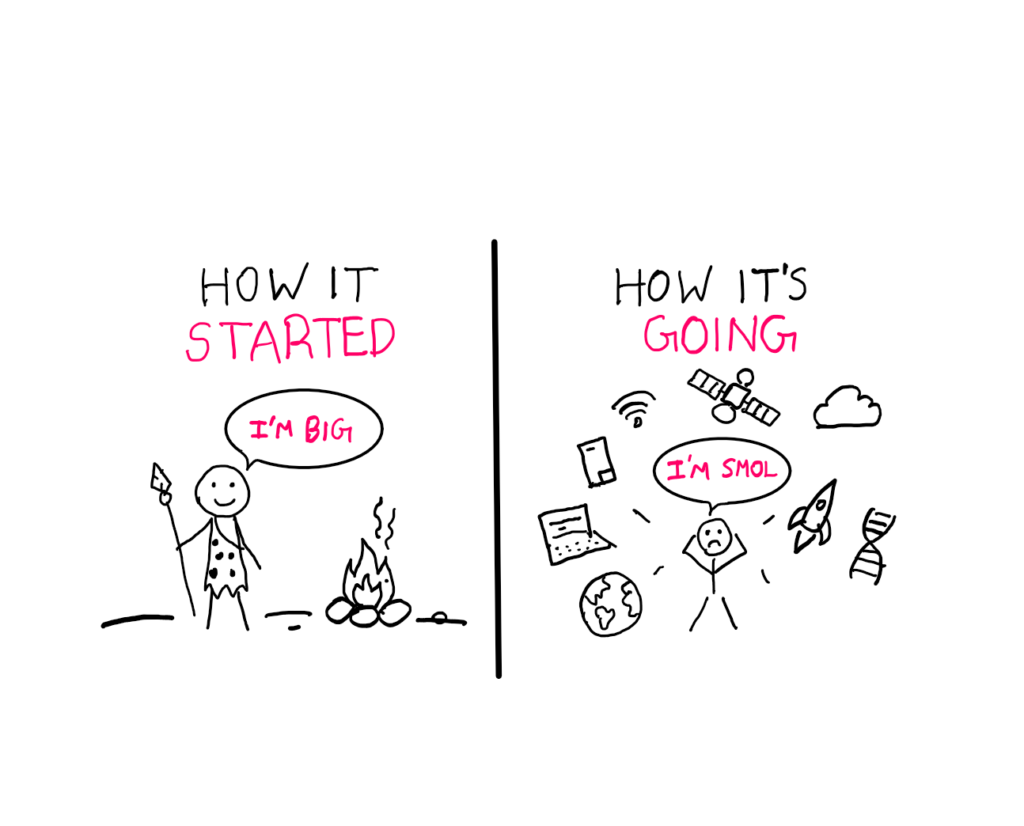
So, having taken a brief look at human tech progress over the past few million years, how could we even complain about our recent rate of progress? Doesn’t our “How it Started / How it’s going…” meme look staggering? Let me try to paint a clearer picture of what our concerns are.
Why Should We Worry About Tech Progress Slowing Down?
To put into context just how much of an acceleration we have been experiencing over the past 200 years or so, around 99.7% of the entire timeline we have been considering lies between the stone tools and until the industrial revolution. Just picture how many key, impactful inventions came after the industrial revolution in the past couple of centuries.
And it is not as if all this tech exists in isolation. Around 200 years back, the typical life expectancy at birth for a human being was ~30 years, and now, it is ~73 years. Isn’t that remarkable? This increase in lifespan is a direct consequence of X-rays (discovered in 1895), Magnetic Resonance Imaging (MRI) (invented in the 1970s), medical sterilisation (invented in 1860s/70s), hyper-fast communication and knowledge-sharing technology, safer food production, sanitation and clean water, and a long list of impactful and consequential innovations and inventions humanity has piled on over the past 200 years. Thanks to all of this technology, human beings are able to lead considerably healthier and safer lives compared to before 200 years ago.
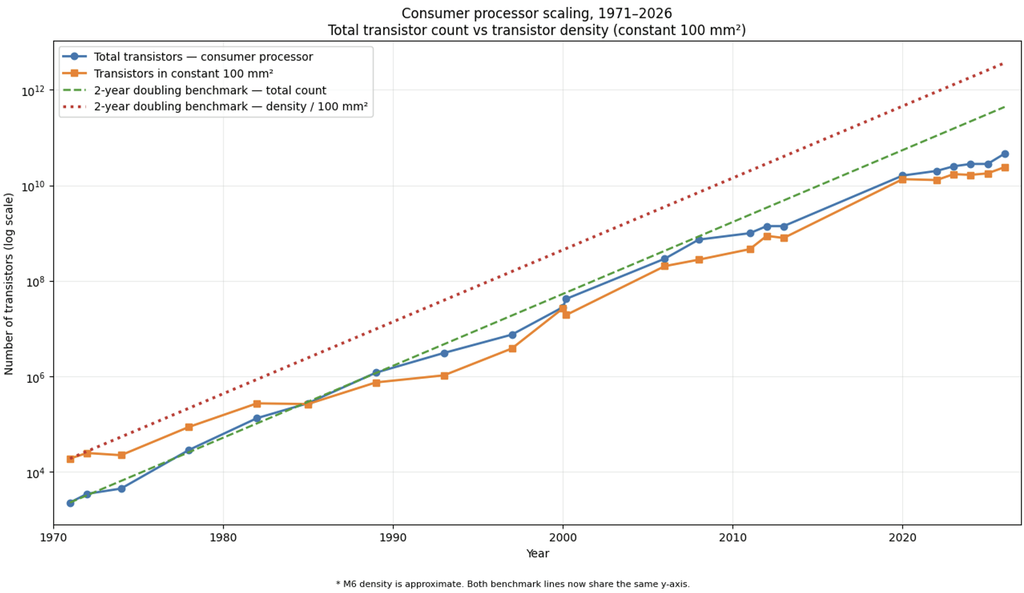
But then, let us come back to the last decade or so. Technological progress, especially in the area of computing, seems to be stagnating in some important areas. This simple version of Gordon Moore’s observation doesn’t hold any more, because we are encountering physical (and economical) limits of how close we can pack transistors into a given space. How can we go smaller than the nanometer-range? We are innovating around this problem, but still, the massive acceleration in processor technology over the past decades came from our ability to pack even more transistors into a given space.
Consumer Processor Scaling (Trasistor count / density) — Plot created by the author (data could be inaccurate)
This situation alone is not necessarily a cause for concern. There are two more factors that are contributing or have contributed to our concern.
Going back to when agriculture developed independently in several parts of the world around 12000 years ago, it is important to note that the world was not even remotely as connected as it is today. People who are into mathematics and science know this pretty well. When similar solutions develop independently and organically across several isolated environments, it is what we could refer to as a global convergence towards a global maxima (or minima, depending on how you look at it). In other words, different societies can arrive at similar technological solutions to similar problems without simply copying one another.
Fast forward to today, our world is extremely well connected via the internet, etc. Although this gives us many, many advantages because of network effects, we lose some of the so-called island effect. Essentially, today, the entire world acts like one interconnected civilisation. Once a technological development goes “viral”, the whole world wants in, at least partly because of the fear of losing out to competition. This in turn takes out global conversion towards a local maxima or a minima. In other words, this causes capital, talent and hardware to converge on the same technological trend.
If we have many civilisations converge on a tech trend independently, without any network effects between them, we could say that the trend is genuinely a global convergence for humanity. But now, since the entire world acts like one interconnected civilisation, all we can say/ask is “What if?”
Some years ago, crypto-currency and blockchains took off, and a significant percentage of the world’s computing power went into this trend. This contributed to graphics card (GPU → Graphics Processing Unit) shortages and higher prices, squeezing the supply that could otherwise have been used for gaming, personal computing, research and other computational workloads.
Similarly, a few years ago, machine learning, AI, and Large Language Models became a trend and became a sink for GPUs initially, and high-performance memory later on. This phenomenon has not matured yet. We are still in its wake. Venture Capital and investment firms are throwing so much capital at it, that the entire supply chain has rearranged itself around the needs big corporations and data centres.
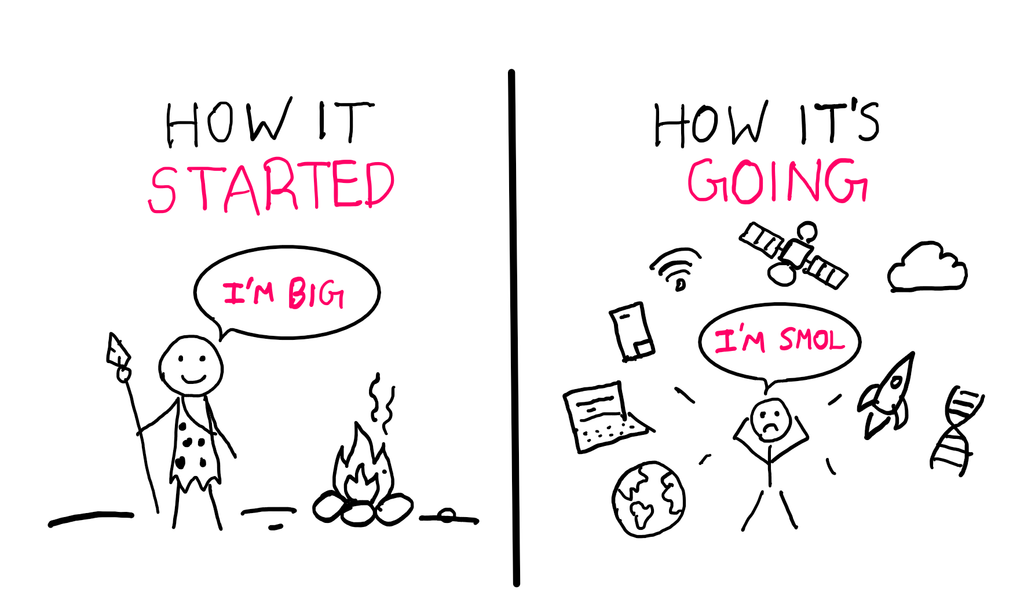
How it Started and How it’s Going — Illustration created by the author
Not only are personal computers hardly getting faster than, say, 5 years ago, but the “relative” high-end hardware is getting more expensive by the day as well. This reduces the innovation potential of individual and private enthusiasts. In essence, this is what we might refer to as a local maxima/minima. In other words, we may be concentrating an enormous amount of technological effort around a small number of globally dominant trends.
If the world were not as connected, there might be several competing trends like these, with different societies independently exploring different technological directions. Some of those directions might eventually converge on something entirely different from what our globally connected system prioritises today. But now, all we can really ask is: “What if?”
This, to me, is a genuine cause for concern. However, is it reason enough to go into a doom-and-gloom mode?
Conclusion
Technological Progress has seldom remained exclusive to one field. Be it stone tools, agriculture or microprocessors, when one field accelerates and matures, some other field takes over the batton.
Although progress in computing technology is currently stagnating in key areas, we are still innovating in other areas like gene-tech, microbiology, space travel (reusable rockets are quite something), etc. So, in my opinion, there is plenty of reason to remain optimistic about the global rate of tech progress.
But at the same time, what is happening with the computer hardware supply chain is unfortunate and needs to get better. Humanity has to try and islandise its efforts towards technology research and development, thereby preserving some sort of tech diversity. Global “virality” is a trap.
As to how this could be done, there are several possibilities. Better regulation, agreements/treaties between nations, diversified public research funding, deliberate support for independent research, etc., could be options. Science has to decouple itself from social media-like behaviour, so that whatever happens to be trending does not automatically absorb a disproportionate share of our attention and resources. I am not even convinced that social media, in its current form, is a net positive for technological progress.
It is clear that there are several problems to solve. Even so, I remain optimistic about humanity’s rate of technological progress in the grander scheme of things over a longer timeline!
If you’d like to get notified when interesting content gets published here, consider subscribing.
We use cookies on our website to give you the most relevant experience by remembering your preferences and repeat visits. By clicking “Accept”, you consent to the use of ALL the cookies.
This website uses cookies to improve your experience while you navigate through the website. Out of these, the cookies that are categorized as necessary are stored on your browser as they are essential for the working of basic functionalities of the website. We also use third-party cookies that help us analyze and understand how you use this website. These cookies will be stored in your browser only with your consent. You also have the option to opt-out of these cookies. But opting out of some of these cookies may affect your browsing experience.
Necessary cookies are absolutely essential for the website to function properly. These cookies ensure basic functionalities and security features of the website, anonymously.
Cookie
Duration
Description
cookielawinfo-checkbox-advertisement
1 year
Set by the GDPR Cookie Consent plugin, this cookie is used to record the user consent for the cookies in the "Advertisement" category .
cookielawinfo-checkbox-analytics
11 months
This cookie is set by GDPR Cookie Consent plugin. The cookie is used to store the user consent for the cookies in the category "Analytics".
cookielawinfo-checkbox-functional
11 months
The cookie is set by GDPR cookie consent to record the user consent for the cookies in the category "Functional".
cookielawinfo-checkbox-necessary
11 months
This cookie is set by GDPR Cookie Consent plugin. The cookies is used to store the user consent for the cookies in the category "Necessary".
cookielawinfo-checkbox-others
11 months
This cookie is set by GDPR Cookie Consent plugin. The cookie is used to store the user consent for the cookies in the category "Other.
cookielawinfo-checkbox-performance
11 months
This cookie is set by GDPR Cookie Consent plugin. The cookie is used to store the user consent for the cookies in the category "Performance".
CookieLawInfoConsent
1 year
Records the default button state of the corresponding category & the status of CCPA. It works only in coordination with the primary cookie.
viewed_cookie_policy
11 months
The cookie is set by the GDPR Cookie Consent plugin and is used to store whether or not user has consented to the use of cookies. It does not store any personal data.
Functional cookies help to perform certain functionalities like sharing the content of the website on social media platforms, collect feedbacks, and other third-party features.
Performance cookies are used to understand and analyze the key performance indexes of the website which helps in delivering a better user experience for the visitors.
Cookie
Duration
Description
_gat
1 minute
This cookie is installed by Google Universal Analytics to restrain request rate and thus limit the collection of data on high traffic sites.
Analytical cookies are used to understand how visitors interact with the website. These cookies help provide information on metrics the number of visitors, bounce rate, traffic source, etc.
Cookie
Duration
Description
__gads
1 year 24 days
The __gads cookie, set by Google, is stored under DoubleClick domain and tracks the number of times users see an advert, measures the success of the campaign and calculates its revenue. This cookie can only be read from the domain they are set on and will not track any data while browsing through other sites.
_ga
2 years
The _ga cookie, installed by Google Analytics, calculates visitor, session and campaign data and also keeps track of site usage for the site's analytics report. The cookie stores information anonymously and assigns a randomly generated number to recognize unique visitors.
_ga_R5WSNS3HKS
2 years
This cookie is installed by Google Analytics.
_gat_gtag_UA_131795354_1
1 minute
Set by Google to distinguish users.
_gid
1 day
Installed by Google Analytics, _gid cookie stores information on how visitors use a website, while also creating an analytics report of the website's performance. Some of the data that are collected include the number of visitors, their source, and the pages they visit anonymously.
CONSENT
2 years
YouTube sets this cookie via embedded youtube-videos and registers anonymous statistical data.
Advertisement cookies are used to provide visitors with relevant ads and marketing campaigns. These cookies track visitors across websites and collect information to provide customized ads.
Cookie
Duration
Description
IDE
1 year 24 days
Google DoubleClick IDE cookies are used to store information about how the user uses the website to present them with relevant ads and according to the user profile.
test_cookie
15 minutes
The test_cookie is set by doubleclick.net and is used to determine if the user's browser supports cookies.
VISITOR_INFO1_LIVE
5 months 27 days
A cookie set by YouTube to measure bandwidth that determines whether the user gets the new or old player interface.
YSC
session
YSC cookie is set by Youtube and is used to track the views of embedded videos on Youtube pages.
yt-remote-connected-devices
never
YouTube sets this cookie to store the video preferences of the user using embedded YouTube video.
yt-remote-device-id
never
YouTube sets this cookie to store the video preferences of the user using embedded YouTube video.


Comments