At various points in my childhood, my father would play back a tape recording for our family. The recording was of a “conversation” between my father and toddler-me, who had probably just learned to talk (sounding more like a robot parrot). It was hilarious and cute at the same time, and my father probably relished the nostalgia as he shared the moment with us.
The conversation went something like this:
My father: Do you want the little toy or the big toy?
Toddler-me: Silence (the brain gears probably grinding and computing what the question means)
My father: Come on. Which one do you want?
Toddler-me: I want both! The big toy AND the small toy (followed by a high-pitched scream)
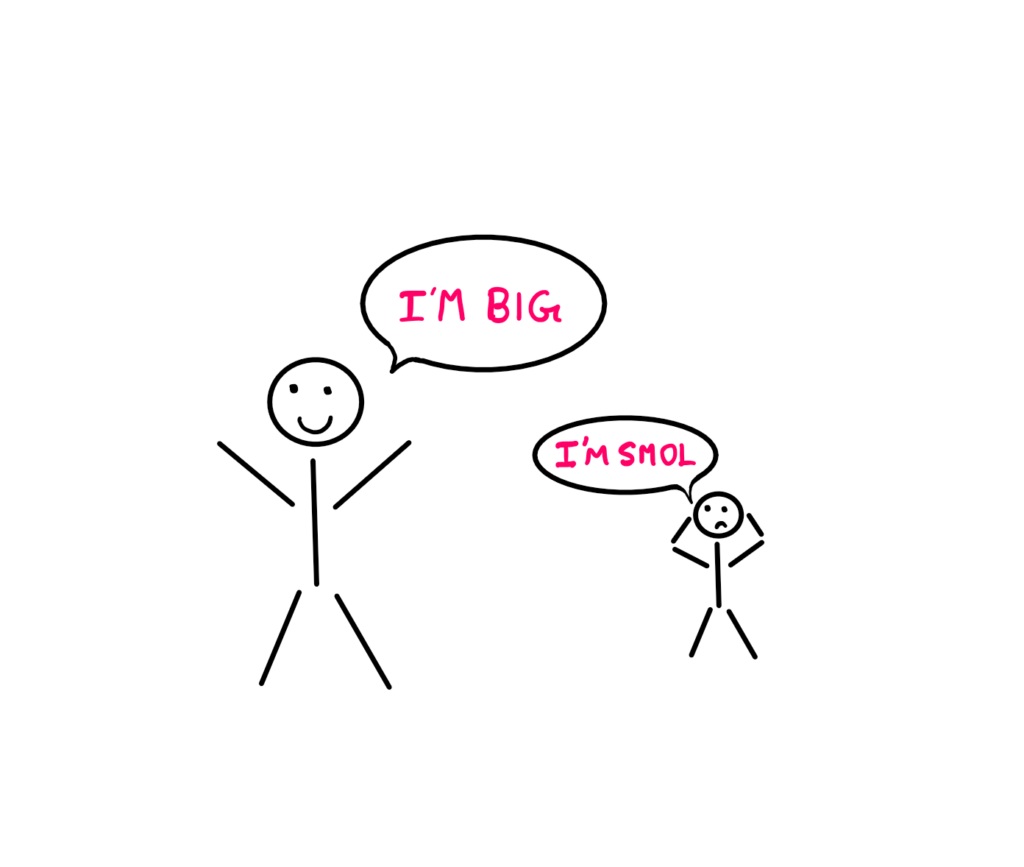
While that is indeed a cute and funny memory, there is a slightly deeper reason as to why I recollect this in the context of understanding scale. Toddler-me, who could barely speak, grasped the fundamental difference between big and small and what value each toy offered. The meta-point here is that even beings with relatively low intelligence levels (sorry, toddler-me!) understand scale innately. Toddler-me is a surprisingly good example because the reference level compares well with many other species as well (dogs, cats, bears, crows, etc.), which means a grasp of scale is not just a human phenomenon, but a more natural one.
Having said that, everything has its limits, and so does our understanding of scale. In this essay, I will be trying to venture out there to explore our understanding of scale and hopefully capture where our limits lie. One strong assumption I make throughout the essay is that we, human beings, have the best understanding of scale on our planet. I could be wrong here, of course, but of all the species on our planet, human beings are the most technologically advanced, which amplifies and aids our understanding of scale. So, my assumption that we know best when it comes to scale seems fair to me.
With that out of the way, let me begin at the roots.
The Origins of Scale
To me, it appears that the origins of scale are bound (at least) to the following words: time, survival, evolution, comparison, growth, decay, etc. Most living beings seem to have a reasonable feel for time, be it logical or something more biological like a circadian rhythm or similar. Animals know when to sleep, when to hunt, use logic to deduce that more food > less food, bigger prey > less prey, too much water = bad, etc.
Of the small list of words that I wrote above, one word in particular draws my interest more than others: “comparison”. This is because it relates to all of the other words: something grows or decays compared to what it is now, future time is later compared to now or the past, etc.
Extending the concept of comparison a step further, I feel that all intelligent species have their natural sense of scale rooted in their size (as this is their reference to compare everything else against). Their survival mechanisms and biology/anatomy have evolved to aid them survive their respective environments on a scale range that they typically operate in.
Take human beings, for instance. Our vision typically ranges from 380 to 750 nanometers (nm)in wavelength (400 THz — 780 THz) of visible light (electromagnetic radiation (EMR)), and our hearing sense typically ranges from 20 Hz to 20,000 Hz.
Phenomena like infrared light (780 nm — 1 m) and ultraviolet light (100–400 nm) are typically beyond our vision capabilities, but we still feel them as heat, sunburn, etc. Other species have other operating ranges of sight and sound, of course. Certain insects, birds, and fish can see infrared and/or ultraviolet. The mantis shrimp (also known as the rainbow shrimp) has one of the best/broadest vision systems that we are aware of. It can see/detect light (EMR) wavelengths ranging from ultraviolet to (near-)infrared.
When it comes to hearing/sound, while our range is from 20 Hz to 20000 Hz, dogs operate in the 45 Hz to 45000 Hz range, whereas cats operate in the 35Hz to 65000 Hz range.
Elephants communicate often below 20Hz, which we are not able to hear. Dolphins, whales, bats, etc., use ultrasound (>20 KHz) for echolocation, often well above the 100 KHz range. One of the highest upper-bound sound-range detections we know of is the greater wax moth. This species can detect sound frequencies up to 300 KHz, probably an evolutionary response to detect and evade echolocating bats, which operate in the upper bound of the lower 2xx KHz range.
Greater Wax Moth — Image from Wikimedia Commons (Credit: Simon Hinkley & Ken Walker, Museum Victoria)
Many species can detect earthquakes because the quakes propagate as infrasound waves (<20Hz), whereas we cannot normally hear these sound waves. Other species can detect weather patterns, which also emit infrasound waves (<20 Hz).
If we cannot detect beyond our range of sight and sound, how did we find out the operating ranges of all these species? Well, that is where our affinity to technology comes in.
Technology to Scale
Our curiosity and hunger to understand everything we come across as a collective species, and our desire to constantly push our limits have gotten us very far. We use so-called Extremely Low-Frequency (EMF) radio-waves (~3 KHz) for submarine communication. These waves have lengths in the range of ~ 100,000 Km and penetrate seawater. We have found use for even lower frequency sound in lab and research settings. When it comes to the upper end of our technological capabilities to detect EMR (light), we have detected cosmic (gamma) rays in the range of ~ 10²⁸ Hz.
Mind you, our limit when it comes to the upper limit of EMR is ~ 10⁴³ Hz, which is known as the Planck frequency. This is a theoretical limit, as it is based on our current understanding of the physics of our universe. Who knows? As our understanding deepens in the future, the resolution might change (I’m fairly confident it will).
When it comes to sound, our seismometers can go as low as ~ 0.001 Hz, whereas our micro-barometers are used to detect meteoric phenomena in space.
On the upper bound of sound, we use ultrasound for detecting medical phenomena, testing materials (for micro-crack detection, for instance — I have done this in the past), etc. When you think about it, we call pressure waves “sound”, as our eardrums detect it. But at extremely high frequencies (subatomic “wave” lengths), the concept of sound breaks down and gives rise to “phonons”. Beyond phonons, there is no “pressure” to deal with in a classical sense; we deal with vibration, thermal radiation (heat), electromagnetic radiation, etc.
I have just touched upon sight and sound here, but it gives us a peek into the scale of what our technology has enabled us to achieve. We could keep exploring other human senses. But what about the scale of phenomena beyond our technological adventures?
Financial Scale
The average person in the world is earning less as the time goes by. The global debt seems to be of the order of ~ 3.X x10¹⁴ US dollars, while all money ever created on Earth is of the order of 1.X x 10¹⁴. The promise of more money to be earned dangles enough carrots for our systems to keep going and growing.
If I naively extrapolate recent past growth rates (this is highly unlikely; so please take it with a pinch of salt), in 200 years, we will have created ~ 10²⁰ US dollars of money and ~10²¹ US dollars in debt. To be frank with you, our system is due for a catastrophic failure at some point in the next 200 years, so maybe things will slow down at some point.
If you think these numbers are huge, why don’t we venture a little further from our little planet?
Cosmological Scale
We think 10¹⁷ seconds have passed since the Big Bang and that there are 10¹⁸ grains of sand on the Earth.
We also estimate that there are more than 100 billion stars in our Milky Way galaxy and that there are ~ 10²⁴ stars in the whole universe (a very rough calculation: 10¹² stars per galaxy times 10¹² galaxies).
Milky Way Galaxy — Image from Wikimedia Commons (Credit: ESO/Y. Beletsky)
The diameter of the observable universe is more than 90 billion lightyears (which is ~ 10²⁶ metres). We think the age of the universe is ~ 13 billion years (~10¹⁷ seconds. The largest known black holes weigh ~ 10⁴⁰ Kg.
Then comes the Eddington number (named after astrophysicist Arthur Eddington), which is 1.57 x 10⁷⁹, an estimate of the number of protons in the entire universe.
I believe there are 15747724136275002577605653961181555468044717914527116709366231425076185631031296 protons in the universe and the same number of electrons.
– Arthur Eddington
To take it one more notch further (at least for this essay), we estimate that the heat death of the universe would occur somewhere around ~10¹⁰⁰ (more on this number in a bit) years.
These numbers are truly staggering in scale. But physics or cosmology is not where our limits of scale truly lie. That cake goes to mathematics.
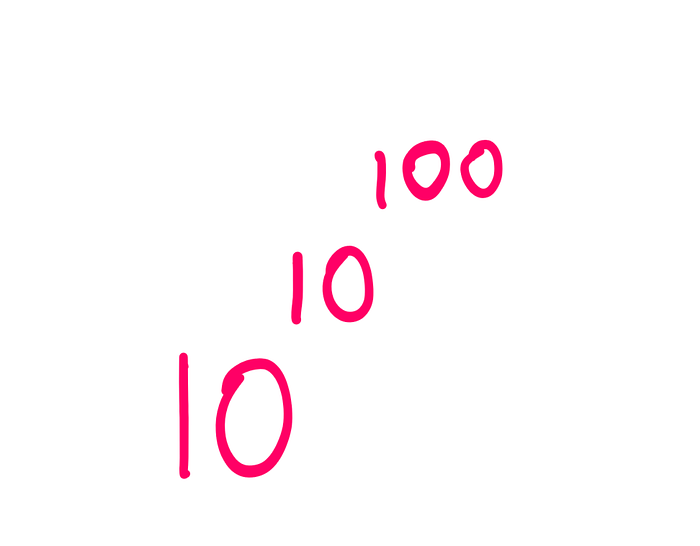
When Larry Page and Sergey Brin were for looking a website for their new product, their colleague Sean Anderson heard the suggestion “googolplex” from someone and either misheard or misunderstood it and typed in google.com. Googolplex is 10 raised to the power of googol, which is 10 raised to the power of 100. In essence, googolplex is the tower exponentiation of 10¹⁰^¹⁰⁰.
Googolplex — Illustration created by the author (It is not possible to write out Googolplex, by the way!)
These are huuuge numbers, far beyond anything we deal with in day-to-day life! But the world of pure mathematics gets crazier.
Googolplex fades in comparison with Graham’s number (named after Ronald Graham). Graham’s number is so huge that it can never be computed in full. It is described using a recursive algorithm that was defined by Ronald Graham to describe an upper bound for a mathematical problem he was working on. It requires 64 layers of special notation to be described.
Based on graph theory, there exists a function TREE(n). TREE(1) = 1 and TREE(2) = 3. But at n=3, that is TREE(3), the output number is so large that we cannot represent this number digitally within our observable universe! In comparison, Graham’s number shrinks much, much smaller in scale.
Yet, there are even larger numbers called Rayo’s number (makes TREE(3) look infinitesimal) and Busy Beaver numbers (BB(6) > 10³⁶⁵³⁴ whereas BB(7) has not been exactly solved yet).
Beyond all of this exists the big daddy of all concepts — infinity! There actually exist multiple levels of infinities, which enable mathematicians to deal with different scales of uncountable abstract concepts.
We have come a long way from reflecting upon the scale of sight and sound to pondering upon the scale of abstract infinities! Even if it is not much, I am truly inspired by what humanity is capable of and has achieved in such a short time (relatively speaking; think “scale”!).
Back to the Roots
I’d like to wrap this essay up where I started it. Almost each one of us, even the most brilliant of the human beings that have walked the Earth, started where I did when the toddler-me compared the value of a big toy with a small toy. I find this thought somewhat inspring and motivating to go out there scale what you feel is yours to scale and accomplish!
As for my childhood, for the worth of me, I cannot recollect what happened after that conversation between my father and toddler-me. I can only hope that greedy little toddler-me got both toys.
If you’d like to get notified when interesting content gets published here, consider subscribing.
We use cookies on our website to give you the most relevant experience by remembering your preferences and repeat visits. By clicking “Accept”, you consent to the use of ALL the cookies.
This website uses cookies to improve your experience while you navigate through the website. Out of these, the cookies that are categorized as necessary are stored on your browser as they are essential for the working of basic functionalities of the website. We also use third-party cookies that help us analyze and understand how you use this website. These cookies will be stored in your browser only with your consent. You also have the option to opt-out of these cookies. But opting out of some of these cookies may affect your browsing experience.
Necessary cookies are absolutely essential for the website to function properly. These cookies ensure basic functionalities and security features of the website, anonymously.
Cookie
Duration
Description
cookielawinfo-checkbox-advertisement
1 year
Set by the GDPR Cookie Consent plugin, this cookie is used to record the user consent for the cookies in the "Advertisement" category .
cookielawinfo-checkbox-analytics
11 months
This cookie is set by GDPR Cookie Consent plugin. The cookie is used to store the user consent for the cookies in the category "Analytics".
cookielawinfo-checkbox-functional
11 months
The cookie is set by GDPR cookie consent to record the user consent for the cookies in the category "Functional".
cookielawinfo-checkbox-necessary
11 months
This cookie is set by GDPR Cookie Consent plugin. The cookies is used to store the user consent for the cookies in the category "Necessary".
cookielawinfo-checkbox-others
11 months
This cookie is set by GDPR Cookie Consent plugin. The cookie is used to store the user consent for the cookies in the category "Other.
cookielawinfo-checkbox-performance
11 months
This cookie is set by GDPR Cookie Consent plugin. The cookie is used to store the user consent for the cookies in the category "Performance".
CookieLawInfoConsent
1 year
Records the default button state of the corresponding category & the status of CCPA. It works only in coordination with the primary cookie.
viewed_cookie_policy
11 months
The cookie is set by the GDPR Cookie Consent plugin and is used to store whether or not user has consented to the use of cookies. It does not store any personal data.
Functional cookies help to perform certain functionalities like sharing the content of the website on social media platforms, collect feedbacks, and other third-party features.
Performance cookies are used to understand and analyze the key performance indexes of the website which helps in delivering a better user experience for the visitors.
Cookie
Duration
Description
_gat
1 minute
This cookie is installed by Google Universal Analytics to restrain request rate and thus limit the collection of data on high traffic sites.
Analytical cookies are used to understand how visitors interact with the website. These cookies help provide information on metrics the number of visitors, bounce rate, traffic source, etc.
Cookie
Duration
Description
__gads
1 year 24 days
The __gads cookie, set by Google, is stored under DoubleClick domain and tracks the number of times users see an advert, measures the success of the campaign and calculates its revenue. This cookie can only be read from the domain they are set on and will not track any data while browsing through other sites.
_ga
2 years
The _ga cookie, installed by Google Analytics, calculates visitor, session and campaign data and also keeps track of site usage for the site's analytics report. The cookie stores information anonymously and assigns a randomly generated number to recognize unique visitors.
_ga_R5WSNS3HKS
2 years
This cookie is installed by Google Analytics.
_gat_gtag_UA_131795354_1
1 minute
Set by Google to distinguish users.
_gid
1 day
Installed by Google Analytics, _gid cookie stores information on how visitors use a website, while also creating an analytics report of the website's performance. Some of the data that are collected include the number of visitors, their source, and the pages they visit anonymously.
CONSENT
2 years
YouTube sets this cookie via embedded youtube-videos and registers anonymous statistical data.
Advertisement cookies are used to provide visitors with relevant ads and marketing campaigns. These cookies track visitors across websites and collect information to provide customized ads.
Cookie
Duration
Description
IDE
1 year 24 days
Google DoubleClick IDE cookies are used to store information about how the user uses the website to present them with relevant ads and according to the user profile.
test_cookie
15 minutes
The test_cookie is set by doubleclick.net and is used to determine if the user's browser supports cookies.
VISITOR_INFO1_LIVE
5 months 27 days
A cookie set by YouTube to measure bandwidth that determines whether the user gets the new or old player interface.
YSC
session
YSC cookie is set by Youtube and is used to track the views of embedded videos on Youtube pages.
yt-remote-connected-devices
never
YouTube sets this cookie to store the video preferences of the user using embedded YouTube video.
yt-remote-device-id
never
YouTube sets this cookie to store the video preferences of the user using embedded YouTube video.





Comments